
What you need to know about HSK 3.0
HSK 3.0 officially launches worldwide in December 2026, bringing updated vocabulary requirements and a new nine-level framework to the HSK exam.
If you’ve studied with HSK before, you’ll notice some significant differences, particularly in the vocabulary expected at each level and how the levels are structured. Here’s what you need to know about HSK 3.0.
Three Stages, Nine Levels
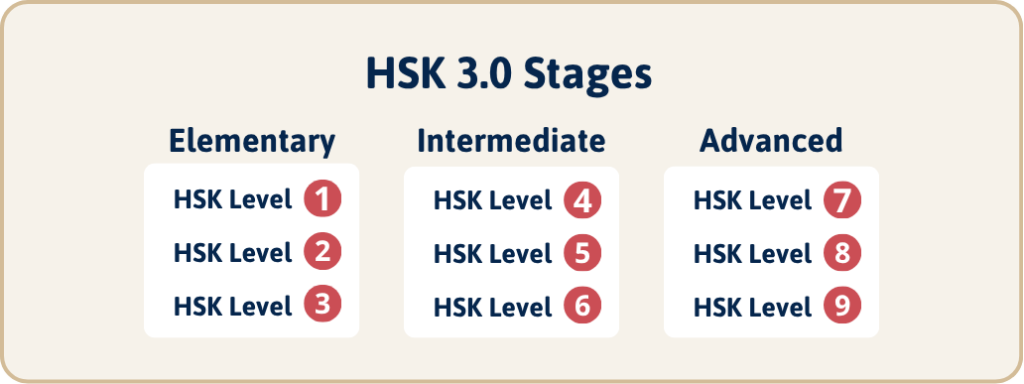
HSK 3.0 uses a “Three Stages, Nine Levels” framework. The nine HSK levels are grouped into three stages:
HSK 2.0 vs. HSK 3.0 Vocabulary
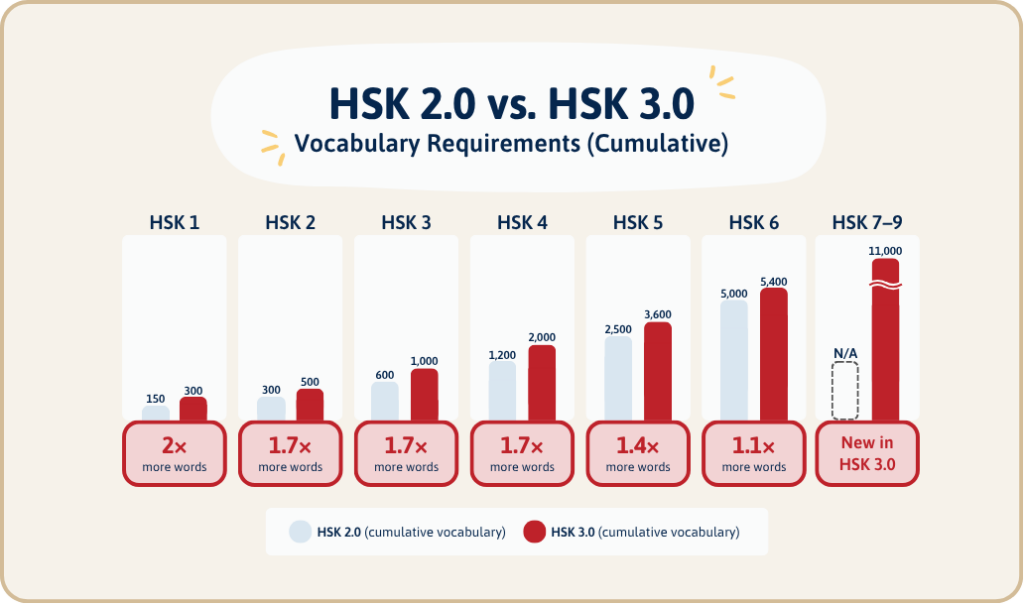
One of the biggest changes in HSK 3.0 is the vocabulary required at each level. HSK 3.0 not only includes more vocabulary overall, but also distributes that vocabulary differently across the levels. Here’s how the cumulative vocabulary requirements compare:
Some earlier HSK 3.0 materials were based on the 2021 Chinese Proficiency Grading Standards. However, the official HSK exam syllabus released in 2025 includes an updated vocabulary list, so learners should refer to the latest syllabus when preparing for the exam.
If you’ve already studied using HSK 2.0 or the 2021 vocabulary list, this doesn’t mean you have to start over. Much of what you’ve learned will still be relevant, but you may encounter new vocabulary or meanings at different stages as you move into HSK 3.0.
Beyond Vocabulary
Vocabulary isn’t the only area changing with HSK 3.0. For writing, the new framework distinguishes between characters learners are expected to write and those they only need to recognize.
Previously, HSK 2.0 offered a completely separate HSKK speaking exam. With the updated HSK 3.0 framework, Levels 3 to 6 include a mandatory, level specific speaking test.
Overall, HSK 3.0 sets more explicit expectations for character writing, grammar, speaking, and other language skills.
What About HSK 7–9?
HSK 7–9 make up the advanced stage of HSK 3.0 and are designed for learners who need to use Chinese in complex academic, professional, social, and other advanced contexts.
Unlike Levels 1–6, there aren’t three separate exams for Levels 7, 8, and 9. Instead, learners take one combined advanced exam, and the final result determines whether they achieve HSK 7, HSK 8, or HSK 9.
Preparing for HSK 3.0 with Du Chinese
Whether you’re preparing for an HSK exam or simply using HSK as a guide for your Chinese studies, reading can help you reinforce vocabulary, encounter words in context, and build your overall Chinese proficiency.
We’re updating Du Chinese to support HSK 3.0 with updated vocabulary labels, HSK 3.0 aligned-stories, and HSK 3.0-aligned courses. Our graded reading levels will remain the same, with HSK 3.0 providing an additional layer for learners following the framework.
For a closer look at how Du Chinese supports HSK 3.0, including how you can transition from HSK 2.0, see How to Prepare for HSK 3.0 with Du Chinese.
If you want to view test dates, find a test center, or want to read the official announcement, check out https://www.chinesetest.cn/ for more information.