
How to Prepare for HSK 3.0 with Du Chinese
If you’re learning Chinese, you’ve probably heard about HSK 3.0, the updated version of the Hanyu Shuiping Kaoshi (汉语水平考试), a standardized Chinese proficiency test.
Whether you’re preparing for the HSK exam, continuing your studies after HSK 2.0, or simply curious about how HSK 3.0 fits into your learning, you may be wondering what the changes mean for you.
At Du Chinese, our focus remains the same: helping you build Chinese proficiency through reading. With HSK 3.0, we’re expanding the ways you can connect what you read and learn in Du Chinese with your HSK studies through updated HSK 3.0 vocabulary labels, HSK 3.0-aligned stories, and HSK 3.0-aligned courses.
What Is HSK 3.0?
The Hanyu Shuiping Kaoshi (HSK) is a standardized test that measures Chinese proficiency. Learners use it to track their progress and demonstrate their Chinese ability for academic, professional, and personal goals.
HSK 3.0 is the updated framework for the exam. It expands the vocabulary learners are expected to know and sets updated standards for Chinese proficiency across daily life, study, and work. If you’d like a closer look at the specific differences between HSK 2.0 and HSK 3.0, including changes to vocabulary requirements and the level system, see What you need to know about HSK 3.0.
For learners, one of the most noticeable changes is that the vocabulary associated with each HSK level has changed. If you’ve studied using HSK 2.0 materials, this means your existing knowledge still provides a valuable foundation, but there may be new vocabulary and meanings to learn as you move into HSK 3.0.
And while vocabulary lists can help you understand what you need to learn, knowing a word is only part of developing proficiency. Seeing vocabulary used in sentences and stories helps you understand its meaning, usage, and context.
That’s where Du Chinese can help.
How Du Chinese Supports HSK 3.0
Du Chinese uses its own graded reading level system, developed and maintained by experienced Chinese teachers and content editors based on what is appropriate for learners at each stage. These levels are separate from HSK, but for learners studying for the exam, we’ve added HSK information throughout the app to support their studies.
HSK 3.0 vocabulary labels
We are updating the HSK labels in Du Chinese to reflect the new HSK 3.0 standards, so learners can see relevant HSK level information when reviewing vocabulary.
However, when updating these labels, we didn’t rely on the written word alone. Where relevant, we distinguish between different meanings, parts of speech, pronunciations, and grammatical functions, since the same written word can belong to different HSK levels depending on how it’s used.
For example, 出口 can mean “exit” as a noun or “to export” as a verb.
- 出口 meaning “exit” is HSK 3.0 Level 4
- 出口 meaning “to export” is HSK 3.0 Level 5
By matching HSK 3.0 information to specific vocabulary definitions, the label reflects the particular meaning or use of the word rather than assigning a single HSK level to every occurrence of the same written form.
HSK 3.0-aligned stories
Alongside the structured Course path, HSK 3.0-aligned Stories provide additional opportunities to practice vocabulary through reading.
Rather than aiming to cover all of the vocabulary and grammar for a level, these Stories are designed to give learners more exposure to level-relevant vocabulary across different topics, situations, and types of content. We’ll continue developing HSK 3.0-aligned Stories for additional levels, giving learners even more opportunities to practice HSK vocabulary through reading.
Some of our HSK 3.0-aligned Stories include:


HSK 3.0-aligned courses
If you want a more structured approach to HSK 3.0 vocabulary, Du Chinese has developed a cumulative course path designed to progressively cover the vocabulary for each level.
Each stage builds on the courses before it:


Moving from HSK 2.0 to HSK 3.0
If you’ve already studied Chinese using HSK 2.0, you may not need to start from scratch. Much of what you’ve learned will still be useful, but HSK 3.0 introduces different vocabulary and grammar requirements, so there may be gaps between what you’ve already studied and what you need to learn.
To help with the transition, we’ve compared the HSK 2.0 and HSK 3.0 vocabulary systems and developed additional course content to help fill those gaps.
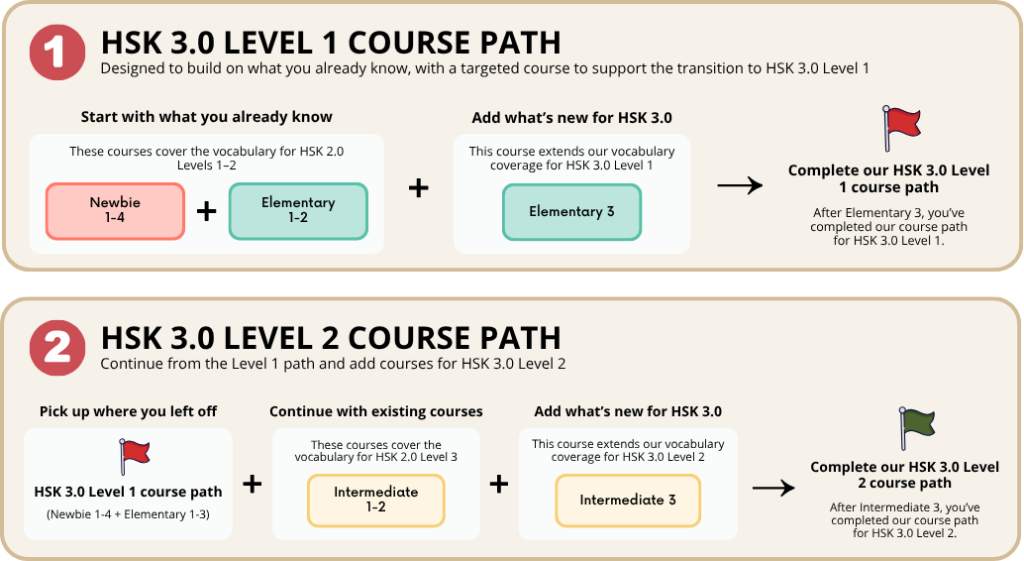
Our HSK 3.0-aligned courses are cumulative and can help you review what you already know while focusing on the vocabulary that’s new to you. If you’d like to review grammar points in more detail, check out our Grammar Points.
Where you start will depend on what you’ve previously studied and how comfortable you are with that material. Our goal is to help you build on the Chinese you already know, fill in the gaps, and keep moving forward with your learning.
Whether you’re preparing for the HSK or simply looking for more structure in your studies, we hope these updates make it easier to connect your HSK goals with the reading you do in Du Chinese.